Lemosho Route
Mount Kilimanjaro

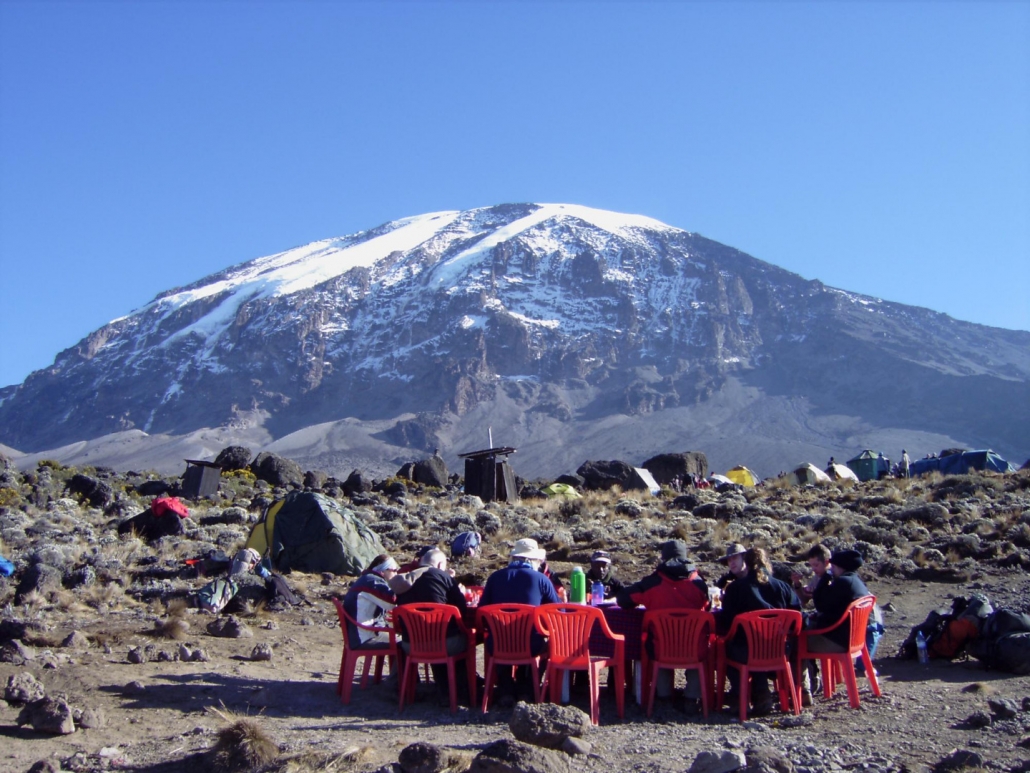
The Lemosho route can be climbed over either 7 or 8 days making it overall a 1o or 11 day itinerary and we offer both options.
The Lemosho route has gained popularity due to it giving good acclimatisation and wonderful views en route. It also has a beautiful approach through the forest from the west before joining the Machame trail at the Shira Plateau and heading to the visually dramatic southern flanks and onto Barafu camp for the summit push. The exit is via Millennium Camp and through Mweka Gate. It is very similar to the Machame route, in that they join up on day 2 / 3 (depending whether you’re doing the 7 or 8 day itinerary) or day two of the Machame itinerary and both follow Kilimanjaro’s southern circuit route to the summit. The full day by day itineraries for both the 7 and 8 day options are found under the ‘Itinerary’ tab here. The main difference in the two itinerary options is that the 8 day version has 4 hrs walking on day 2 on the mountain followed by 3 hours on day 3, whereas the 7 day itinerary combines these days into one 7 hour day.
Adventure Alternative & Kilimanjaro Trek are now in our fourth decade running climbs of Kilimanjaro, and with our own company in Tanzania, we have a reputation for integrity and safe, successful trips. We run climbs of Kilimanjaro every month and our summit success rate is 95%.
We offer five different routes to the top of Kilimanjaro with the most common being the 7 day climb on the Machame Route or this route, the Lemosho, via the 7 or 8 day itinerary. We also have climbs via the 7 day Rongai route from the north of the mountain which is a lesser travelled route, or if you have the time and budget, the ‘connoisseur’s route’ being the 9 day Northern Circuit – whatever route you take, the itinerary is never less than 7 days / 6 nights on the mountain, which gives you the best ability to acclimatise properly to the altitude and will give you the best chances of reaching the summit. If you are confused over which route would suit you best then please don’t hesitate to call or mail us via the ‘Contact Us’ button above or fill in the form below.
Our staff are professional, qualified and experienced. We look after them excellently and in turn they look after you excellently! Our prices are land based and all inclusive including all park fees – there are no hidden kitties or fees. We do not charge additional fees by season and the price you see is the price you pay. We have flexible payments and ask for a £100 deposit (this is included in the advertised trip fee) to secure your place, balances are then due 6 weeks prior to departure. You can log into your account at any time if you’d like to make interim payments.
We are a ,multi-award winning, professional and ethical mountaineering company and can ensure you of a wonderful and enjoyable climb of Mt Kilimanjaro.
You’ll find various details on this website and also on our main Kilimanjaro routes page (click here) – on each route option don’t miss the ‘More Information’ button on the lower right which should cover all your questions and give you some really good hints and tips! Do also feel free to call or email us. We can email you a trip info pack and you won’t reach a ‘sales agent’ but a real person who loves and is experienced in the outdoors and most importantly has climbed Kilimanjaro numerous times!

Find out more and book a life-changing Kilimanjaro Trek at Adventure Alternative
Full breakdown of cost and all inclusions and exclusions can be found here under the ‘Costs’ tab.
The 7 day Machame route is £1895 and people often ask why is it £100 cheaper than the 7 day Lemosho – the reason is additional transport costs for the team, staff and kit to start point of the Lemosho route plus there’s additional fees per person for transiting the forest to reach the start point.
Includes
Excludes
Our prices are competitive and good value, and we offer quality, an excellent service, security and a strong stance on tourism in a developing country. We don’t want to be so expensive to run fewer trips and have our staff idle, but on the other hand we believe that running cheap trips that promote the practise of skimming budgets would result in the porters getting next to nothing, which is something we cannot consider.
Additionally we will only run trips that are 7 days or longer, since any less is dangerous for a peak just short of 6000 metres (equivalent to Camp 1 on Mount Everest). Current National Park and camping fees are included in our trip fee, which are circa USD $1000 per person for a 7 day climb, which makes Kilimanjaro an expensive peak to visit. Reducing the number of days may make the price cheaper but the chances of summiting reduce to around 50% and it is potentially dangerous.
We include lots of support staff plus one guide for every two or three climbers (ratios change depending on the number of climbers but our guide to climber ratio is never greater than 1:3). We do not operate kitties and we use a very good hotel in town who we’ve built up a strong relationship with over many years.
We have our own license to operate tours on Mount Kilimanjaro and are a member of the local Tanzanian Association of Tour Operators.
We advise you to take out travel insurance as soon as you book to cover potential events that might cause you to cancel your trip.
You need to ensure that you have a policy which covers trekking to 5895m, helicopter rescue and cancellation, but it does not need to cover technical climbing. You should bring with you a copy of your policy and ensure your tent mate knows where you keep it. Insurance for Kilimanjaro details can be found by clicking here.
Our main office is on the north coast of N.Ireland but we also have a company, Adventure Alternative Tanzania, with an office, stores, campsite and a guesthouse in Moshi right next to Mount Kilimanjaro. We provide full employment for our subsidiary company alongside excellent rates of pay, equipment, training and career development.
“Superb Leaders”
“Just thought I would drop you a line to say how fantastic an experience the climb was, we loved every minute of it. As you will know we both achieved the summit with no real ill effects from the altitude and best of all no Diamox. Lipman, Godfrey, Kamanda, Simba and John were superb leaders all in their own styles they have my up most respect.”
This is a trek to climb Kilimanjaro via the Lemosho route with no technical requirements, but it does offer a mountain experience which includes camping and being outdoors for the duration of the climb, and walking uphill every day for 7 or 8 days, depending on itinerary, for an average of 5 or 6 hours per day. Any regular hill walker will find climbing Kilimanjaro within his or her capabilities, but also remember that you will be sleeping and eating on the mountain too. The cumulative effect will be tiring and you should mentally prepare for a week of sleeping in a tent and living outdoors, especially if this is new to you.
Training to climb Kilimanjaro should include, if possible, regular hill walking with a small pack of around 10 kgs, and / or regular visits to the gym for the final two months before departure. You should work on strengthening calf and thigh muscles and exercise your cardio-vascular stamina on a step machine or cross trainer, but remember this is a holiday and not a forced march! Don’t approach it as if you are training for a marathon, and remember it must be fun!
The secret of climbing Mt Kilimanjaro is to go slowly and enjoy the scenery, drink well, eat well and sleep well. A lot of people fear that they won’t be able to keep up with the team, however a regular, consistent and slow pace will ensure you properly acclimatisation. Statistically the biggest proportion of failure occurs with young, fit males who go too fast and ignore the simple rules. It’s not a race or a competition and your guide will help you by setting an appropriate pace so that you acclimatise safely!
It’s best to operate on the principle that if you look after yourself well during the first five days, then the sixth ‘summit day’ will be a big challenge but not dangerous. We cannot condone the people who push themselves beyond the bounds of safety and wear the badge of hardship as a medal of honour, perpetuating the image that getting to the summit has an element of masochism to it! “This is just an example of bad mountaineering”, says Director Gavin Bate, “We want people to be clear-headed on the summit, with the strength to come all the way back down again! Drink lots of liquid, eat every meal and go slowly all the way – this is the mantra that my staff will say to you over and over again”.
The terrain on Kilimanjaro varies throughout the ascent and descent, which makes for an interesting and ever changing environment! It’s definitely not a case of simply staring at the persons boots in front of you, instead you can enjoy the views as you pass initially through cultivated farmland, then equatorial forest before reaching the alpine heath land that leads up to a lunar-like volcanic desert which is just below the stunning glaciated summit. Climbing Kilimanjaro is not a technical climb and there are no precipitous drops along the way, no rock climbing ability or specialist equipment is needed.
The paths are in good condition and well trodden; some are steeper than others (in particular the Great Barranco Wall is an exciting scramble) and you will most likely meet other people at the camps and along the trails. On summit day the path is mostly scree, which can be loose and dusty, especially on the descent.
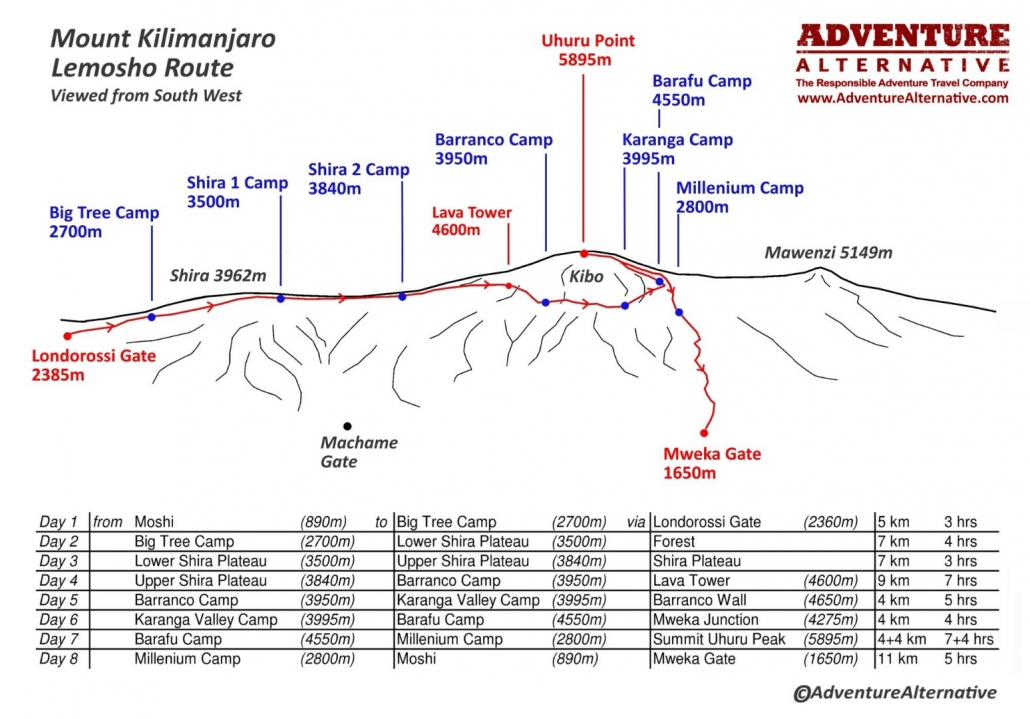
Big Tree Camp and Millennium Camp are on the tree line and have a number of campsites set in small clearings in the forest. You will see a central ranger station and toilet blocks. Mobile coverage is sometimes possible here.
Shira Camp (1 and 2) is situated on the vast Shira plateau which is a volcanic spill-off from the last eruption some 100,000 years ago. It’s the highest plateau on earth and a huge open area which can be exposed and often dusty with smaller, more fragile plants amongst the rocks. There are toilet blocks and Ranger huts around the area. Due to it’s size it’s easy to have some privacy. The 8 day route uses Shira 1 and Shira 2, which are 3 hours walking distance apart. The 7 day itinerary uses only Shira 2.
Barranco Camp is in a big clearing at the head of a steep valley which drops down into the Umbwe route. It’s surrounded by dramatic cliffs and right below the ice fields of Kibo. It’s a stunning location for a camp.
Karanga Camp is a very open camp on the side of a sloping hill with great views of the summit massif and the expanse of land beyond the mountain. At night you look up to the stars above and hundreds of meters below the lights of Moshi town twinkle. Many people go directly from Barranco camp to Barafu camp, so Karanga is traditionally a bit of half-way stop, but there are still toilets and a Ranger hut here.
Barafu, meaning ‘ice’, is now no longer covered in permanent snow but it is cold and rocky and can be exposed. People definitely feel the altitude here and you can expect snow and sometimes high wind. The campsites are dotted amongst nooks and crannies in the rocks which offer some protection. It’s perched on a sort of wide ridge that steepens as it ascends towards the summit.
Climbing Kilimanjaro is a non-technical trek but it does offer a full mountaineering experience. Experience in hill walking is a benefit but not absolutely necessary, since this is a supported climb. You will have however be outdoors constantly and living in tents so any sort of experience with camping will be useful and a good level of training is expected, especially on the thigh and calf muscles.
It is not necessary to have any experience of high altitude to climb Kilimanjaro, and there is nowhere in the United Kingdom or Ireland to possibly train for it. The important factor will be to go slowly, which you guide will assist upon as that will allow your metabolism to adapt to the lower air pressure and the thinner air, and be aware of altitude health at all times.
The staff will carry your main bag up to a maximum weight of 15 kgs plus all the tents, kitchen equipment, mattresses (no need to bring your own), food, fuel, tables and chairs. They will cater for all the group needs, providing excellent meals and putting up the tents. The guides will also brief you daily on the climb. You carry only a day bag which usually weights 5kg as it normally holds your poles, fleece, waterproofs, camera, sunglasses / cream and water in it.
Castro, our operations manager in Moshi. and the Director of Adventure Alternative Tanzania organises all the staff, equipment, permits and hotel arrangements. You will have his telephone number, or the staff at the hotel desk can call him for you. He is organiser, translator, problem-solver, adviser and the main link between you and the UK office. On the mountain you can reach him through the guides as he contacts them every day and can make arrangements while you are up high.
You also have continued support from the main office in Northern Ireland. Should a problem arise of significant proportion then you only need to call us.

If you spend much time in the outdoors then you’ll probably already own most of the gear that you need to climb Kilimanjaro. The is a full Kilimanjaro Packing List here and if there’s anything you don’t have we also hire most items such as sleeping bags, duffle / kit bags, poles etc.
If you’re keen to hire equipment you’ll find a list under the ‘Extras’ tab here. Rental items can be added when you book, or by logging into your account at a later date. It’s also possible to hire other equipment in Moshi directly from our staff in case there is anything that you may have forgotten.
We provide all kitchen equipment and plates, bowls, cutlery and comfortable foam mattresses, there is no need to bring a Therm-A-Rest or camp mat for the mountain.
Find out more and book a life-changing Kilimanjaro Trek at Adventure Alternative
 https://kilimanjaro-trek.com/wp-content/uploads/2019/03/mount-kilimanjaro-1.jpg
1080
1440
advaltSEO
https://kilimanjaro-trek.com/wp-content/uploads/2019/03/kilimanjaroTrekLogo-redBlack-1030x407.png
advaltSEO2019-03-12 13:57:532019-03-12 13:58:41Kilimanjaro Compared to the Other Seven Summits
https://kilimanjaro-trek.com/wp-content/uploads/2019/03/mount-kilimanjaro-1.jpg
1080
1440
advaltSEO
https://kilimanjaro-trek.com/wp-content/uploads/2019/03/kilimanjaroTrekLogo-redBlack-1030x407.png
advaltSEO2019-03-12 13:57:532019-03-12 13:58:41Kilimanjaro Compared to the Other Seven Summits https://kilimanjaro-trek.com/wp-content/uploads/2019/03/tanzania_mount-kilimanjaro-summit-2006-1.jpg
1080
1440
advaltSEO
https://kilimanjaro-trek.com/wp-content/uploads/2019/03/kilimanjaroTrekLogo-redBlack-1030x407.png
advaltSEO2019-03-12 13:43:582019-03-15 10:03:50What to Wear on Kilimanjaro?
https://kilimanjaro-trek.com/wp-content/uploads/2019/03/tanzania_mount-kilimanjaro-summit-2006-1.jpg
1080
1440
advaltSEO
https://kilimanjaro-trek.com/wp-content/uploads/2019/03/kilimanjaroTrekLogo-redBlack-1030x407.png
advaltSEO2019-03-12 13:43:582019-03-15 10:03:50What to Wear on Kilimanjaro? https://kilimanjaro-trek.com/wp-content/uploads/2019/03/loo-with-a-view.jpg
2448
3264
advaltSEO
https://kilimanjaro-trek.com/wp-content/uploads/2019/03/kilimanjaroTrekLogo-redBlack-1030x407.png
advaltSEO2019-03-12 13:38:592019-03-12 13:40:11Kilimanjaro Toilets
https://kilimanjaro-trek.com/wp-content/uploads/2019/03/loo-with-a-view.jpg
2448
3264
advaltSEO
https://kilimanjaro-trek.com/wp-content/uploads/2019/03/kilimanjaroTrekLogo-redBlack-1030x407.png
advaltSEO2019-03-12 13:38:592019-03-12 13:40:11Kilimanjaro Toilets https://kilimanjaro-trek.com/wp-content/uploads/2019/03/Mount-Meru.jpg
1365
2048
advaltSEO
https://kilimanjaro-trek.com/wp-content/uploads/2019/03/kilimanjaroTrekLogo-redBlack-1030x407.png
advaltSEO2019-03-12 13:22:452019-03-12 13:31:11Climb Kilimanjaro for Charity!
https://kilimanjaro-trek.com/wp-content/uploads/2019/03/Mount-Meru.jpg
1365
2048
advaltSEO
https://kilimanjaro-trek.com/wp-content/uploads/2019/03/kilimanjaroTrekLogo-redBlack-1030x407.png
advaltSEO2019-03-12 13:22:452019-03-12 13:31:11Climb Kilimanjaro for Charity! https://kilimanjaro-trek.com/wp-content/uploads/2019/03/kilimanjaro-views.jpg
404
539
advaltSEO
https://kilimanjaro-trek.com/wp-content/uploads/2019/03/kilimanjaroTrekLogo-redBlack-1030x407.png
advaltSEO2019-03-12 13:13:082019-03-12 13:16:35Do I use Diamox on Kilimanjaro?
https://kilimanjaro-trek.com/wp-content/uploads/2019/03/kilimanjaro-views.jpg
404
539
advaltSEO
https://kilimanjaro-trek.com/wp-content/uploads/2019/03/kilimanjaroTrekLogo-redBlack-1030x407.png
advaltSEO2019-03-12 13:13:082019-03-12 13:16:35Do I use Diamox on Kilimanjaro? https://kilimanjaro-trek.com/wp-content/uploads/2019/03/kilimanjaro-1203937_1920.jpg
1208
1920
advaltSEO
https://kilimanjaro-trek.com/wp-content/uploads/2019/03/kilimanjaroTrekLogo-redBlack-1030x407.png
advaltSEO2019-03-12 13:05:542019-03-12 13:16:55Why Kilimanjaro is a great mountain for any bucket list
https://kilimanjaro-trek.com/wp-content/uploads/2019/03/kilimanjaro-1203937_1920.jpg
1208
1920
advaltSEO
https://kilimanjaro-trek.com/wp-content/uploads/2019/03/kilimanjaroTrekLogo-redBlack-1030x407.png
advaltSEO2019-03-12 13:05:542019-03-12 13:16:55Why Kilimanjaro is a great mountain for any bucket listBe it an enquiry, feedback, or just a simple message to say hi, we want to hear what you have to say!