Charity Treks
Mount Kilimanjaro


We organise numerous charity climbs of Kilimanjaro every year and they range from inspired solo fundraisers aiming to help a local charity that is close to their heart to large private group climbs for national and international charities. If you would like more details about climbing Kilimanjaro for your own charity please contact us, the details are at the bottom of this page or through the ‘Contact Us’ button in the menu above. Do also have a read of our blog ‘How to climb Kilimanjaro for Charity‘
At 5895 metres, a climb Kilimanjaro is a fantastic charity challenge, not to be underestimated, but entirely feasible for a hill walker looking to combine a high mountain adventure, with raising funds for a charity whilst enjoying the magic of a trip to Africa. As a charity trek it is well known but for good reason, it’s a fantastic climb to the roof of Africa and a really enjoyable experience. We offer pre-trip advice such as which route is best on Kilimanjaro, training tips for climbing Kilimanjaro and we go the extra mile for charities, at no extra cost and can provide materials for recruitment, media / PR, plus we’re happy to give advice directly to your supporters, or one of our team could attend a launch / kit night, or even join you on a training day out in the hills.
The rest of this page and the prices shown relate to our annual charity climb of Kilimanjaro which raises funds for our charitable arm, The Moving Mountains Trust. If you would like further details about Moving Mountains have a look at our website: www.movingmountainstrust.org. Or if you’d like a chat about organising a climb for your charity, please do get in touch, we’d love to hear from you!
Moving Mountains’ work includes educational support programmes, construction and development of school facilities and vital community infrastructure, support for health programmes and medical centres, environmental projects, capacity building work and support for organizational development, vocational training and employment and economic development initiatives. So as well as taking part in a truly magical trek of a lifetime to the top of the highest mountain in Africa, you’ll also help us to continue to move mountains for disadvantaged children, families and communities across the world.
Please see movingmountainstrust.org for more information and details of all of the charity’s projects and programmes across the world.

Find out more and book a life-changing Kilimanjaro Trek at Adventure Alternative
Includes
Excludes
Our prices are competitive and good value, and we offer quality, an excellent service, security and a strong stance on tourism in a developing country. We don’t want to be so expensive to run fewer trips and have our staff idle, but on the other hand we believe that running cheap trips that promote the practise of skimming budgets would result in the porters getting next to nothing, which is something we cannot consider.
Additionally we will only run 7 day trips, since any less is dangerous for a peak just short of 6000 metres (equivalent to Camp 1 on Mount Everest). Current National Park and camping fees are included in our trip fee and are circa USD $150 per person per day, which makes Kilimanjaro an expensive peak to visit. Reducing the number of days may make the price cheaper but the chances of summiting reduce to around 50% and it is potentially dangerous.
We include lots of support staff plus one guide for every two or three climbers (ratios change depending on the number of climbers but our guide to climber ratio is never greater than 1:3). We do not operate kitties and we use a very good hotel in town with which we have built up a strong relationship for the past twenty years.
We have our own license to operate tours on Mount Kilimanjaro and are a member of the local Tanzanian Association of Tour Operators.
“Superb Leaders”
“Just thought I would drop you a line to say how fantastic an experience the climb was, we loved every minute of it. As you will know we both achieved the summit with no real ill effects from the altitude and best of all no Diamox. Lipman, Godfrey, Kamanda, Simba and John were superb leaders all in their own styles they have my up most respect.”
The terrain on Kilimanjaro varies throughout your climb period, which depending on your route could be anywhere from 7 to 9 days, ascending from 2000m to 5895m and back down, you’ll pass through cultivated farmland, equatorial forest and alpine heathland, then cross a lunar-like volcanic desert and up to the glaciated summit. Climbing Kilimanjaro is not a technical climb and there are no precipitous drops along the way, no rock climbing or specialist equipment is needed. Most people will already own most of the clothing on the Kilimanjaro Kit List and if missing anything, like a good sleeping bag, or a liner, poles etc can be rented directly from us.
The paths are in good condition and well trodden; some are steeper than others (in particular the Great Barranco Wall is an exciting scramble) and you will most likely meet other people at the camps and along the way. On summit day the path is mostly scree, which can be loose and unrelenting, especially on the descent but it’s ever changing and there’s plenty of help and support for you.
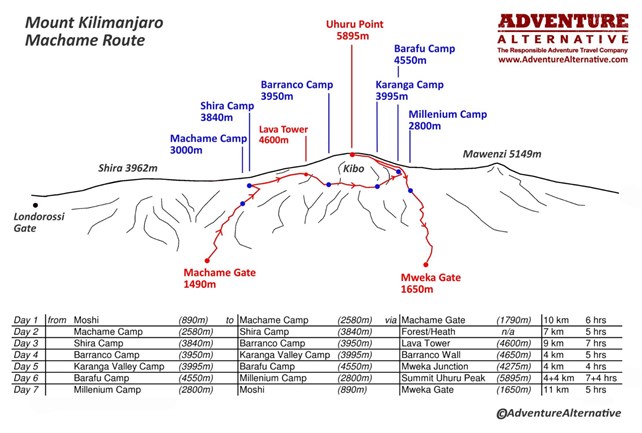
There are many different routes on Kilimanjaro, we can have a chat about which suits you or your team best. The routes range from 7 to 9 days. Below as an example of what you can expect at the camps is those used on the Machame trail.
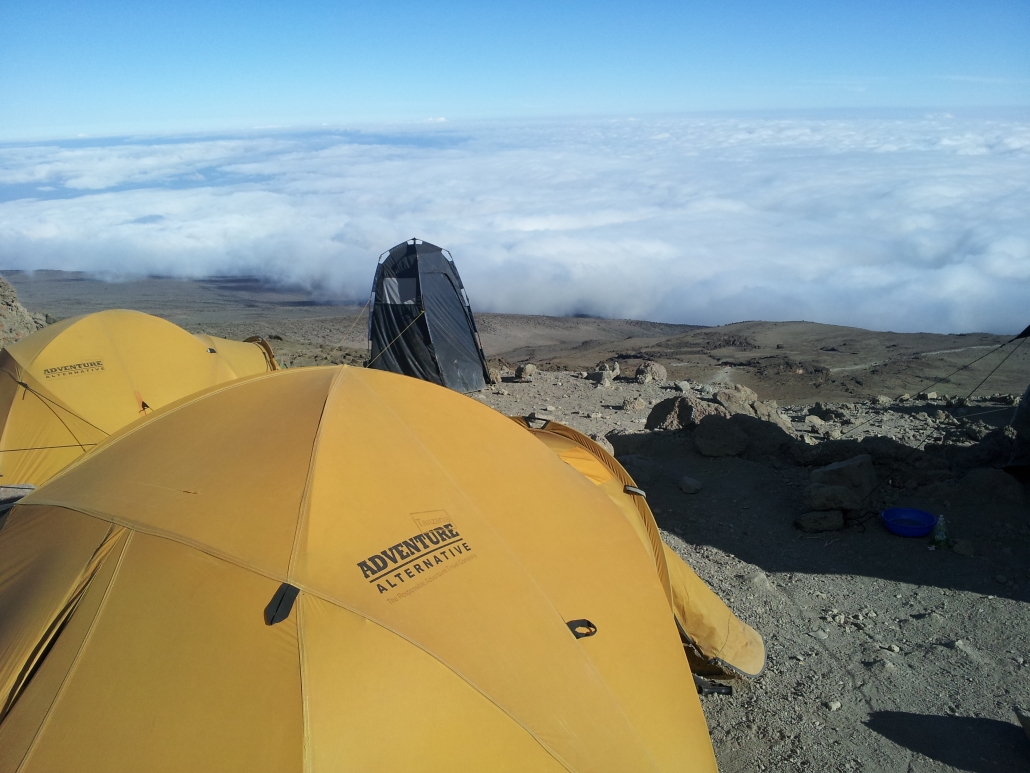
Machame and Millennium Camp are on the tree line and have a number of campsites set in small clearings in the forest. You will see a central ranger station and a number of toilet blocks which have some western loos, but mostly long drops. Most people ask about the toilets on Kilimanjaro – click here for details! Mobile coverage is at times possible at these camps and both are close to the National Park gates.
Shira Camp is situated on the vast Shira plateau which is a volcanic spill-off from the last explosion some 100,000 years ago. It’s also the highest plateau on earth! It’s open and can be exposed. It can also be dusty with smaller, more fragile plants amongst the rocks. Toilets and Ranger huts are around and the area is so huge it is easy to have some privacy.
Barranco Camp is in a big clearing at the head of a steep valley which drops down into the Umbwe route, it’s nestled below dramatic cliffs and right below the ice fields of Kibo, a stunning location for a camp.
Karanga Camp is a very open camp on the side of a hillside with great views of the summit massif and the expanse of land beyond the mountain including the lights of Moshi which can be seen at night, many hundreds of meters below. Many people go direct from Barranco to Barafu, so Karanga is traditionally a bit of half-way stop, but there are still latrines and a Ranger hut here.
Barafu, meaning ‘ice’, is now no longer covered in permanent snow but it is cold and rocky and exposed. People definitely feel the altitude here and you can expect snow and sometimes high wind. The camp sites are dotted amongst nooks and crannies in the rocks, perched below the ridge that leads up to the summit itself.
Climbing Kilimanjaro is a non-technical trek, not a climb, but it does offer a full mountaineering experience. Experience in hill walking is a benefit but not absolutely necessary, since this is a supported climb. You will have however be outdoors constantly and living in tents so any sort of experience with camping will be useful and a good level of training is expected, especially on the thigh and calf muscles.
It is not necessary to have any experience of high altitude to climb Kilimanjaro, and there is nowhere in the United Kingdom or Ireland to possibly train for it. The important factor will be to go slowly and allow your metabolism to adapt to the lower air pressure and the thinner air, and be aware of altitude health at all times.
The staff will carry your main bag up to a maximum weight of 15 kgs plus all the tents, kitchen equipment, food, fuel, tables and chairs. They will cater for all the group needs, providing excellent meals and putting up the tents. You need to bring your personal kit, as per the kit list below and a sleeping bag – we provide mattresses. You will only carry a small day bag with your water, a rain coat and some snacks. The guides will also brief you daily on the climb.
Castro is our operations manager in Moshi and Director of Adventure Alternative Tanzania. He organises all the staff, equipment, permits and hotel arrangements. You will have his telephone number, or the staff at the hotel desk can call him for you. He is organiser, translator, problem-solver, advisor and the main link between you and the UK office whilst you’re in Tanzania. He talks to the guides every day on the mountain and can make arrangements while you are up high.
You also have continued support from the main office in Northern Ireland. For charity climbs we offer additional training and support for groups, in the form of visits and powerpoints and advice on training for the trip.
We don’t charge any extra for charity climbs of Kilimanjaro, in fact we offer them at a discount based on the number of climbers. We don’t hold charities to stringent contracts either, and nor do we apply punitive financial costs for groups falling below an agreed number. We don’t mind if a charity has two or fifty people, we simply give you a price per person based on your itinerary and varying numbers of climbers.
Most trekkers or hill walkers will already own the kit required to climb Kilimanjaro and if not most if it can be rented or cheaply purchased. There are not technical requirements on the mountain and no technical kit needed. For a full Kilimanjaro Kit list or packing click here or see below.
Paracetamol
Ibuprofen
Antiseptic Wipes
Adhesive Plasters
Blister Plasters
Zinc Tape
Insect Repellent
Antihistamine tablets
Sunblock Cream
Water Purification Tablets
Rehydration Sachets
Personal Medication as required:
eg. Anti-Malarials, Asthma Inhalers, Insulin, Epi-Pen etc
Lip Salve
Throat Lozenges
Latex gloves
Crepe Bandage
Hydrocortisone Cream
Prochlorperazine tablets (for sickness/nausea)
Ciprofloxacin tablets (general antibiotic; prescription required)
Acetazolamide tablets (altitude prophylactic; prescription required)
Note: you must check with your GP for your personal suitability to all medicines and their possible side effects and interactions. Please inform us of the details of all regular medication that you intend to use though the course of your trip and any relevant allergies and medical history related to them. You also need to check the requirements and regulations of the airline and all countries visited in relation to medications. For example; laws governing transport of some pain control medication and the need to keep insulin at a suitable temperature, ie not in the cargo hold.
Find out more and book a life-changing Kilimanjaro Trek at Adventure Alternative
 https://kilimanjaro-trek.com/wp-content/uploads/2019/03/mount-kilimanjaro-1.jpg
1080
1440
advaltSEO
https://kilimanjaro-trek.com/wp-content/uploads/2019/03/kilimanjaroTrekLogo-redBlack-1030x407.png
advaltSEO2019-03-12 13:57:532019-03-12 13:58:41Kilimanjaro Compared to the Other Seven Summits
https://kilimanjaro-trek.com/wp-content/uploads/2019/03/mount-kilimanjaro-1.jpg
1080
1440
advaltSEO
https://kilimanjaro-trek.com/wp-content/uploads/2019/03/kilimanjaroTrekLogo-redBlack-1030x407.png
advaltSEO2019-03-12 13:57:532019-03-12 13:58:41Kilimanjaro Compared to the Other Seven Summits https://kilimanjaro-trek.com/wp-content/uploads/2019/03/tanzania_mount-kilimanjaro-summit-2006-1.jpg
1080
1440
advaltSEO
https://kilimanjaro-trek.com/wp-content/uploads/2019/03/kilimanjaroTrekLogo-redBlack-1030x407.png
advaltSEO2019-03-12 13:43:582019-03-15 10:03:50What to Wear on Kilimanjaro?
https://kilimanjaro-trek.com/wp-content/uploads/2019/03/tanzania_mount-kilimanjaro-summit-2006-1.jpg
1080
1440
advaltSEO
https://kilimanjaro-trek.com/wp-content/uploads/2019/03/kilimanjaroTrekLogo-redBlack-1030x407.png
advaltSEO2019-03-12 13:43:582019-03-15 10:03:50What to Wear on Kilimanjaro? https://kilimanjaro-trek.com/wp-content/uploads/2019/03/loo-with-a-view.jpg
2448
3264
advaltSEO
https://kilimanjaro-trek.com/wp-content/uploads/2019/03/kilimanjaroTrekLogo-redBlack-1030x407.png
advaltSEO2019-03-12 13:38:592019-03-12 13:40:11Kilimanjaro Toilets
https://kilimanjaro-trek.com/wp-content/uploads/2019/03/loo-with-a-view.jpg
2448
3264
advaltSEO
https://kilimanjaro-trek.com/wp-content/uploads/2019/03/kilimanjaroTrekLogo-redBlack-1030x407.png
advaltSEO2019-03-12 13:38:592019-03-12 13:40:11Kilimanjaro Toilets https://kilimanjaro-trek.com/wp-content/uploads/2019/03/Mount-Meru.jpg
1365
2048
advaltSEO
https://kilimanjaro-trek.com/wp-content/uploads/2019/03/kilimanjaroTrekLogo-redBlack-1030x407.png
advaltSEO2019-03-12 13:22:452019-03-12 13:31:11Climb Kilimanjaro for Charity!
https://kilimanjaro-trek.com/wp-content/uploads/2019/03/Mount-Meru.jpg
1365
2048
advaltSEO
https://kilimanjaro-trek.com/wp-content/uploads/2019/03/kilimanjaroTrekLogo-redBlack-1030x407.png
advaltSEO2019-03-12 13:22:452019-03-12 13:31:11Climb Kilimanjaro for Charity! https://kilimanjaro-trek.com/wp-content/uploads/2019/03/kilimanjaro-views.jpg
404
539
advaltSEO
https://kilimanjaro-trek.com/wp-content/uploads/2019/03/kilimanjaroTrekLogo-redBlack-1030x407.png
advaltSEO2019-03-12 13:13:082019-03-12 13:16:35Do I use Diamox on Kilimanjaro?
https://kilimanjaro-trek.com/wp-content/uploads/2019/03/kilimanjaro-views.jpg
404
539
advaltSEO
https://kilimanjaro-trek.com/wp-content/uploads/2019/03/kilimanjaroTrekLogo-redBlack-1030x407.png
advaltSEO2019-03-12 13:13:082019-03-12 13:16:35Do I use Diamox on Kilimanjaro? https://kilimanjaro-trek.com/wp-content/uploads/2019/03/kilimanjaro-1203937_1920.jpg
1208
1920
advaltSEO
https://kilimanjaro-trek.com/wp-content/uploads/2019/03/kilimanjaroTrekLogo-redBlack-1030x407.png
advaltSEO2019-03-12 13:05:542019-03-12 13:16:55Why Kilimanjaro is a great mountain for any bucket list
https://kilimanjaro-trek.com/wp-content/uploads/2019/03/kilimanjaro-1203937_1920.jpg
1208
1920
advaltSEO
https://kilimanjaro-trek.com/wp-content/uploads/2019/03/kilimanjaroTrekLogo-redBlack-1030x407.png
advaltSEO2019-03-12 13:05:542019-03-12 13:16:55Why Kilimanjaro is a great mountain for any bucket listBe it an enquiry, feedback, or just a simple message to say hi, we want to hear what you have to say!